


Let’s get one thing out of the way up top: America First was never an anti-interventionist slogan—not in the 1930s and certainly not today. That the slogan convinced millions of Trump supporters that they were voting against cavalier use of our military makes no difference. The shocking thing about January 3rd isn’t that Trump has decided to overthrow a foreign government after a decade of saying he wouldn’t (for reasons I’ll get into later), but the way he did it. If the administration pulls this off, it will change the world forever. We will enter an entirely new era of geopolitics. But I’m getting ahead of myself.
You already know what happened. On January 3rd, over 150 aircrafts converged onto Venezuela. They knocked out the country’s air defenses and bombed five different sites, including the country’s main Caribbean port and a major telecomms tower. Amidst this chaos, helicopters dropped a Delta Force team into Nicolas Maduro’s compound. They abducted the President and his wife, then fought their way out with only a few “self-defense engagements.” The FBI took custody of the duo and delivered them to the Southern District of New York, where they await charges of narco-terrorism, conspiracy to import cocaine, and possession of machine guns (a weapon that America’s largest gun rights organization believes we should be able to buy without a license, by the way). The United States military, General John “Raizin” Caine tells us, “remain[s] in the region at a high state of readiness.”
It looks, sounds and smells like a forever war, and Trump’s initial press conference did little to counter that impression. “We’re not afraid of boots on the ground if we have to,” he said. What will those boots be doing? “We’re going to run the country right.” Who will do the running? “The people that are standing right behind me…and others”—Pete Hegseth, Marco Rubio and other unnamed alcoholics/terminally anxious fuck-ups, I assume. For how long? “Until such time as we can do a safe, proper, and judicious transition.” And how will we know when that glorious time has come? “We have to rebuild their whole infrastructure. Their infrastructure is rotted…Oil is very dangerous. It’s a very dangerous thing to take out of the ground.” Who will rebuild that oil infrastructure? “It’ll be paid for by the oil companies directly. They will be reimbursed for what they’re doing.” With taxpayer dollars? Through oil profits? Impossible to say.
It sure sounds like we’re in this for the long haul at first listen, and the situation could easily end up that way whether the Trump administration wants it to or not. But I do not think the administration intends to invade Venezuela. They believe they’ve found a way to enforce their will, inside and outside Venezuela, without invading anyone at all—and it’s very, very America First.
Trump’s speech was clear—crystal clear, without ambiguity—which means administration toadies will now spend days interpreting his words like some old biblical scroll and insisting he didn’t say the things everyone heard him say. This time, the job fell to Secretary of State Marco Rubio, who embarked on the Sunday talk show circuit to explain that we are not “running Venezuela” while simultaneously assuring us that every word that comes out of Trump’s mouth is true and good and wise.
“Well I’ve explained once again, and I’ll do it one more time: what we are running is the direction that this is going to move, moving forward,” Rubio, visibly sweating and vampire-victim pale, told George Stephanopoulos on ABC. The muscles in his face contracted spastically as he explained why targeting oil tankers is completely legal, which is not what Stephanopoulos asked or what anybody cares about right now.
It took ten minutes of Stephanopoulos repeatedly asking his initial question—are we running Venezuela? Are you running Venezuela?—for Rubio to acknowledge the events of January 3rd at all. “This was not an invasion. We didn’t occupy the country,” he insisted. “This was a law enforcement operation. He was arrested on the ground, in Venezuela, by FBI agents, read his rights, and removed from the country.”
(Maduro was not arrested by the FBI. He was captured by Delta Force, as mentioned above, during an operation in which multiple branches of the armed forces worked together to bomb five separate locations. Nobody believes that law enforcement nonsense; it’s patently absurd and meant to be absurd, because one of the many things this invasion accomplishes is to strip yet more power from Congress. Rubio is lying on national TV so that, if challenged, the administration can waste time in court arguing their untenable position until enough time passes that their inevitable defeat does not matter. Same playbook they’ve been running for a year.)
We still do not have answers to some very important questions. Are we running Venezuela or not? Do we intend to force regime change, or not? Will there be boots on the ground, or are we really just going to kidnap a head of state, do a victory lap, and leave?
When the administration throw this much smoke, the best thing to do is listen for repeated phrases or sentiments, especially across multiple interviews. If someone says something repeatedly, chances are it’s a talking point—not off-the-cuff pablum, but a pre-planned message. The nice thing about an administration that lies as easily as drawing breath is that they never deliver unpleasant truths. Every word out of their mouths is something they want us to think, feel, and believe. We can’t learn the truth through their talking points, but we can learn a lot about their strategy.
During that initial press conference, Trump said some variation of “run the country” a whopping 14 times. Four of those instances involved the phrase “run [the country] properly.” The president also used the word “judiciously” — as in a “safe, proper and judicious transition”—quite injudiciously; more times, I suspect, than he has used it before in his entire life. Trump wasn’t speaking out of pocket as he so often does: these talking points were the purpose of that press conference. Which is odd, because people emphatically do not want us to run Venezuela. Why does the Trump administration want the people to believe he’s going to do something unpopular?
Marco Rubio’s talking point—in the press conference and on the talk show circuit—seems to be that the President is a very serious person who does not “play games” and follows through on his threats. He found many ways to say this, but repeated some variant of “if [Trump] says he’s serious about something, he means it” at least twice in both the press conference and his Sunday NBC interview. This talking point seems designed to counter the Trump Always Chickens Out trope that’s dogged this administration’s foreign policy ever since the tariff rollercoaster got going nine months ago.
Trump and Rubio’s talking points combine into a message intended not for the people of America, but for the heads of state in Cuba, Columbia, and worldwide. The message itself is simple, elegant, and ugly: do exactly what we say or America will destroy you—not your country, or your economy, or your people, but you, personally. This strategy doesn’t just let America “run” Venezuela. It allows this administration to “run” any country unable to attack us on our home turf: extract their resources, dictate their domestic policy, force their leaders to resign. All by credibly threatening extreme personal violence against any head of state who pushes back.
Credit where credit is due: it’s an entirely new approach to colonialism. Here’s how it’s worked since Britain perfected the art: you invade the country, then place the opposition party in power. That party requires your support to maintain control (if they had enough force to do it themselves they’d already be in charge). In exchange for military backup, their leader will do anything you ask.
Trump, on the other hand, has endorsed Maduro’s Vice President, Delcy Rodríguez, allegedly because the opposition party “doesn’t have the support within, or the respect within the country.” This assertion is aggressive nonsense. Opposition party weakness is a feature, not a bug, for the reasons stated above. It’s also patently untrue in this case. Election monitors from several countries agree that candidate Edmundo González Urrutia beat Maduro in a landslide two years ago by as much as 51 percent. Trump and his allies know this—they’ve used Maduro’s election theft to justify invasion. It’s kind of perfect: the party doesn’t have the power to gain power by themselves, but they’re popular enough to minimize the danger of revolt. It’s the dream situation—so why isn’t the Trump administration going for it?
Most people seem to think Trump’s endorsement of the unpopular and hostile Rodríguez stems from bitterness towards María Corina Machado, the opposition party leader who received the Nobel Peace Prize that Trump wanted so badly last year. Machado seems to think so too; she’s offered to give the prize to Trump and spent ten minutes abasing herself before the Peace President on Hannity yesterday. It won’t help. Trump is petty to the core, it’s true, but Stephen Miller and the other ghouls actually running this country would never set the entire colonial playbook on fire just to appease some old queen’s ego.
The real reason, I suspect, is this: leaving Rodríguez in charge is the only move that does not require a full-scale invasion.
Unlike Machado, Rodríguez possesses a military and police force capable of holding Venezuela together. Under the old model, that force would have threatened our hegemony, but under Colonialism 2.0, she has a strong incentive to do exactly as she’s told regardless; she is, after all, one surgical strike away from losing her freedom or possibly her life. As long as she doesn’t call Trump’s bluff or get coup’d herself, it’s foolproof.
But will she acquiesce? “[Rodríguez] had a long conversation with Marco and she said “We’ll do whatever you need,”” the President said during that initial press conference. “I think she was quite gracious, but she really doesn’t have a choice.”
Minutes later, Rodríguez delivered a very different message on Venezuelan state television. “There is only one president in Venezuela, and his name is Nicolas Maduro Moros,” she said in Spanish. “We will never be a colony of any empire…we are ready to defend our natural resources.”
Trump seemed completely unbothered by the declaration—amused, even. “I don’t think there was pushback. I think that, frankly, you hear a different person than I hear,” he said the following evening. Trump of all people understands the need for bluster and posturing to appease one’s furious base. He’s fine with Rodríguez making noises about war crimes and legitimate presidents, especially if it’s in Spanish, as long as she does what he tells her to.
There is no ambiguity about what Rodríguez needs to do to keep her position. It’s all Trump talks about, his inescapable, all-consuming obsession: she must open Venezuela to foreign oil conglomerates and allow them to take possession of the country’s crumbling infrastructure. Rebuild their oil industry and start pumping that black gold out of Venezuela and into the pockets of American billionaires.
And the administration was right: Rodríguez is already rolling over. “We consider it a priority to move towards a balanced and respectful relationship between the US and Venezuela,” she wrote on Telegram late Sunday. “We extend an invitation to the US government to work together on an agenda for cooperation that is aimed towards shared development.” So far, so good.
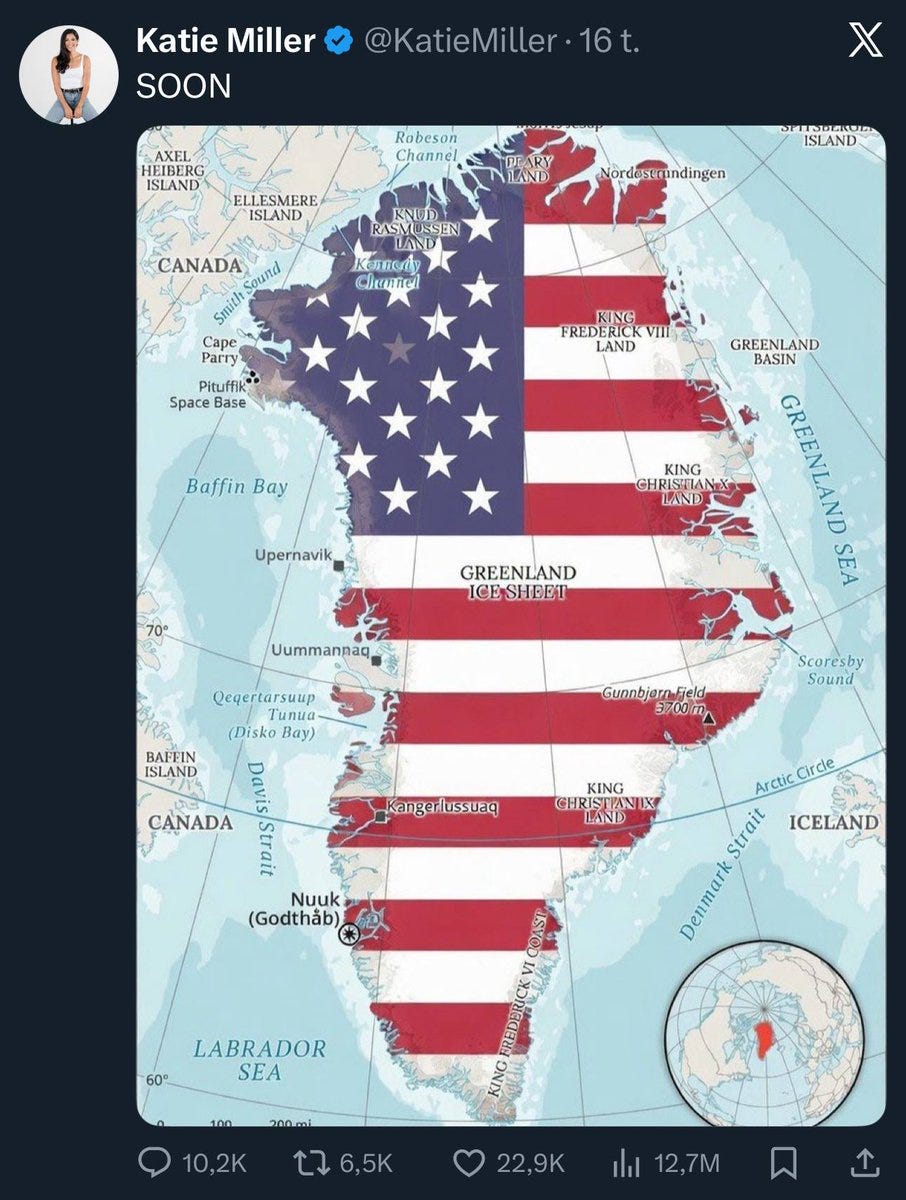
Colonialism 2.0 has implications that go far beyond Venezuela, as demonstrated by the administration’s increasingly bellicose threats towards Columbia, Cuba, and to a lesser extent Mexico. They’re talking about Greenland again for Christ’s sake. We might not be getting a ground war, but we’ve entered a new era of foreign policy regardless.
“You can talk all you want about international niceties and everything else, but we live in a world—in the real world, Jake—that is governed by strength, that is governed by force, that is governed by power. These are the iron laws of the world,” Stephen Miller shouted at Jake Tapper on-air last night. “For [Venezuela] to run an economy, they need our permission. So the United States is in charge.”
It’s an astounding interview, worth watching in full if you can stomach it. Tapper grows increasingly disgusted as the exchange goes off the rails; Miller grows increasingly shrill. The final question: will Venezuela be allowed to hold elections?
“You’re approaching this from the wrong frame!” Miller’s voice rose higher still. “This neoliberal frame, that the United States’ job is to go around the world demanding immediate elections be held everywhere, immediately, all the time, right away. To create these vacuums—”
“That’s not what I think,” Tapper cut in, absolutely baffled. “But you invaded the country. We went into the country, seized the leader of Venezuela—”
“DAMN STRAIGHT WE DID!” Miller screamed, as though climaxing on the White House lawn.
“…so is the US going to have new elections?” Tapper seemed preternaturally calm—belied, perhaps, by that Freudian slip.
“We’re not going to let tinpot communist dictators send rapists into our country, send drugs into our country, send weapons into our country—”
Tapper threw up his hands. “Okay,” he said with quiet, glorious contempt.
“The priority right now, as the President has made clear, is a judicious, thoughtful, careful transition process to secure a great future for Venezuela and to secure a great future for America.”
This is the architect. Writer of the talking points. A caller of shots and a student of history. Miller has always understood the true meaning of America First, which was never a statement of priority and always a statement of status. It does not mean using our wealth for our own citizens instead of outsiders, tending our own garden and leaving others to tend theirs, or any of the other dreck they’ve fed their followers for the last decade. It means that America’s needs, wants, and whims come first. They are the only things that matter—more than the rule of law, or human rights, or the sanctity of life. The world and all its resources belong to us by birthright. Give us what we want, or suffer beneath our boot.
And if this whole thing ends with boots on the ground, with another forever war? That’s America First too, as long as America gets something out of it. Citizens will bleed and die, it’s true, but read the slogan again: it’s America first, not Americans first. Our Homeland is more important than any single person (except perhaps the Leader, who embodies its spirit), and it is certainly more important than some soldier from bumfuck Indiana. Or his widow. Or his orphan.
That war will come—if not today, than tomorrow; if not tomorrow, some other day. A war of expansion, most likely, or to eliminate some existential threat, real or imagined. This kind of nationalism never stays quietly at home; it expands, exploits, devours.
America, America über alles. Über alles in der Welt.
Hail Trump. Hail our people. Hail victory.
"America First" versus "Americans First." Love the attention to language here. I appreciate also the tour through colonialism. The difference it seems between your gen and the neo-liberals of yore is that you see a through line where they dare not make mention of it whatsoever.
The other thing about a war is it enables you to declare a state of emergency and suspend elections.