


Donald Trump is a loser—not in a playground-insult sense, but a definitional one. Trump is a thing that loses; it is his function and his purpose. He is a finely-tuned machine that turns victory into defeat. He is enshittification made flesh.
For 79 long years this virtuoso has honed his craft, and we are blessed to witness his magnum opus. His unprecedented fecal achievement makes Trump Steaks look like a culinary success, Trump! The Game like a cherished family pasttime, and his Atlantic City casino bankruptcies worthy of the Nobel Prize in Economics. Only a few in history have ever matched it.
America isn’t just losing the Iran war in a conventional sense, we’re losing it fractally. A fractal looks the same no matter how far you zoom in or out, and so does this war. From every angle and on every level, the Iran War is an unmitigated, world-bending catastrophe, each aspect somehow stupider than the last.
Let us zoom in on an obscure little branch of this Mandelbrot Disaster. Let us talk about Oman.
Eye of the Storm
Last year, Rest of World tapped me to write about Oman’s space program. I will not bullshit you, dear reader: before this assignment and the three weeks I spent there, I was almost completely unaware of this country’s existence. So were most of the people I know.
Oman, as it turns out, is a country on the Arabian peninsula that sits south of Saudi Arabia and east of Yemen. You won’t find any ski slopes in their deserts, no man-made island resorts off their coasts. Structures like Burj Khalifa aren’t just absent, they’re anathema: the Sultan has forbidden all skyscrapers in favor of traditional architecture. It’s a quietly ambitious nation, with a fierce pride that neither seeks nor requires outside affirmation.
This nation’s geopolitical strategy is as ambitious as it gets for a country in the heart of the Middle East: authentic neutrality. Somehow, they have pulled this off. The country’s majority Ibadi Muslim sect, which sits outside the Sunni/Shia conflict and values both tolerance and hospitality, helps explain their success. Since the strategy’s inauguration in the early 70s, Oman has worked hard to be a friend to all and an enemy to none. The Switzerland of the Middle East, some call them. An oasis of peace in a war-torn region.
Oman uses their unique position to help forge connection and host peace negotiations within the region. They’ve facilitated dialogue between the Saudis and the Houthis, mediated talks between Iran and Iraq. They worked behind the scenes for decades to establish peace between Israel and other Middle Eastern nations. And, most importantly for our story today, they have long served as neutral ground for negotiations between Iran and the USA.
The country gets results. When American backpackers inadvertently wandered into Iranian territory during a trip through Iraq, Oman helped negotiate to get those hikers home. The country has faciliated prisoner swaps between the two nations. Most crucially, Oman mediated Obama’s 2015 nuclear treaty, in which Iran agreed to dial back their nuclear program and the US agreed to lift sanctions (which brought Iranian uranium enrichment to zero before Trump torpedoed it and reinstated sanctions in 2018).
You may have noticed that the United States is not currently negotiating with Iran in Oman. JD Vance is instead flying back and forth to Pakistan: a notably unstable nation with a long history of sponsoring our enemies and the perennial silver medalist of the yearly “Nuclear Power That Shouldn’t Be One” competition, right behind North Korea. This year, they’re going to have to settle for bronze. America has silver pretty much sewn up and may be going for the gold before the year is out.
America is currently testing Pakistan’s patience instead of Oman’s because, for Trump, a country without enemies apparently reads as a challenge. Our president is working hard to alienate a country whose geopolitical and economic importance has never been greater…and Iran is doing its best to take advantage.
The Art Of The Heel
It is spring of 2025. Trump is ratcheting up his anti-Iranian rhetoric. Also, though, he wants that sexy Nobel Peace Prize, so he sends Steve Witkoff and Jared Kushner to Oman to broker a deal. The American and Iranian delegations refused to meet directly, so Oman’s foreign minister, Badr Al-Busaidi, served as both mediator and go-between. Four times, negotiations stalled; four times, Al-Busaidi got them back on track.
And then, on June 13th, Israel launched an attack on Iran. Eight days later, Trump joined in with Operation Midnight Hammer and “totally obliterated” Iran’s nuclear program. Negotiations were over. The delegates went home.
It is February of 2026. Trump and Netanyahu are once again ramping up rhetoric against Iran, which apparently managed to totally rebuild their totally obliterated nuclear program in a matter of months—very impressive. Once again, American and Iranian delegations arrive in Oman to attempt a nuclear deal.
On February 27th, Al-Busaidi announced that a nuclear deal was within reach. Not only had Iran agreed to cease stockpiling weapons-grade uranium, he said, they agreed to degrade all current uranium stockpiles and allow IAEA inspectors to certify compliance. “This is something that is not in the old deal that was negotiated during President Obama's time. This is something completely new,” Al-Busaidi said: an obvious yet skilled attempt to stroke Trump’s ego. “If you cannot stockpile material that is enriched, then there is no way you can actually create a bomb.” Details would take time, the foreign minister said, but “the big main issues, components that really are the main areas of concern, I think that can be agreed tomorrow.”
Hours after Al-Busaidi’s statement, the bombs started falling. “We sought repeatedly to make a deal. We tried,” Trump declared in a pre-recorded statement on Truth Social. “But Iran refused, just as it has for decades and decades.”
“I am dismayed,” Al-Busaidi tweeted in the early hours of what America promised would be a lightning-fast war, over before you know it, definitely not a quagmire. “Neither the interests of the United States nor the cause of global peace are well served by this. And I pray for the innocents who will suffer.” The foreign minister would spend the next two weeks repeatedly trying to get the United States back to the negotiating table. The Trump administration rebuffed every attempt.
Finally, on March 18th, Al-Busaidi publicly broke his silence in an op/ed for The Economist. “The question for friends of America is simple. What can we do to extricate the superpower from this unwanted entanglement?” he wrote. “America’s friends have a responsibility to tell the truth.”
Al-Busaidi told the truth as he sees it. America and Israel’s attack, he wrote, was “a shock but not a surprise.” Iran’s retaliatory strikes against allegedly American targets in neighboring states, while “deeply regrettable and completely unacceptable,” were also “probably the only rational option available to Iranian leadership.”
Like many analysts, Al-Busaidi believes America allowed Israel to drag it into this war against its own national interest. These two countries’ objectives, he argues, are incompatible. Israel “explicitly seeks the overthrow of the Islamic Republic and probably cares little about how the country is governed, or by whom, once this has been achieved.” Only a protracted campaign with American boots on the ground could possibly make that happen. (I wrote something similar a few weeks ago).
America, on the other hand, wants “a decisive end to nuclear weapons proliferation in the region, secure energy supply chains and renewed investment opportunities.” Al-Busaidi and Oman also want these things. Only peace in Iran and a return to bilateral negotiations can make those things happen. “It will certainly be difficult for the Iranian leadership to return to dialogue with an administration that twice switched abruptly from talks to bombing and assassination,” Al-Busaidi acknowledged, but he saw no other way.
Trump, to my knowledge, never responded to any of these points. Why would he? America was winning, is winning, and presumably will stay winning for however many years this farce drags on. You can tell that we are winning by the press conferences we keep having to explain how hard we’re winning—you know, the way a winning person might.
Dire Straits
Here are the most geopolitically important 1.5 paragraphs in Al-Busaidi’s measured yet impassioned plea for peace:
The effects of this retaliation are felt most acutely on the southern side of the Gulf, where Arab countries that had placed their trust in American security co-operation now experience that co-operation as an acute vulnerability, threatening their present security and future prosperity.
For Gulf states an economic model in which global sport, tourism, aviation and technology were to play an important role is now endangered. Plans to become a global hub for data centres may need to be revised.
Oman has the smallest oil reserves of any gulf nation. Their wells are expected to run dry around 2040, which means the country has just 14 years left to transition from a petrostate into literally anything else. To accomplish this, Oman has bet big on agriculture, ports, and the tech industry. Agriculture requires fertilizer, which requires oil. Tech companies want geopolitical stability. And ports? Ports…are complicated.
Oman has three deep-water ports that sit just outside the Strait of Hormuz. These ports are connected to modern and well-maintained roads that allow for land transport of oil. Gulf states and ships alike are beginning to use these ports to circumvent the strait. From a purely economic standpoint, this development is fantastic for Oman.
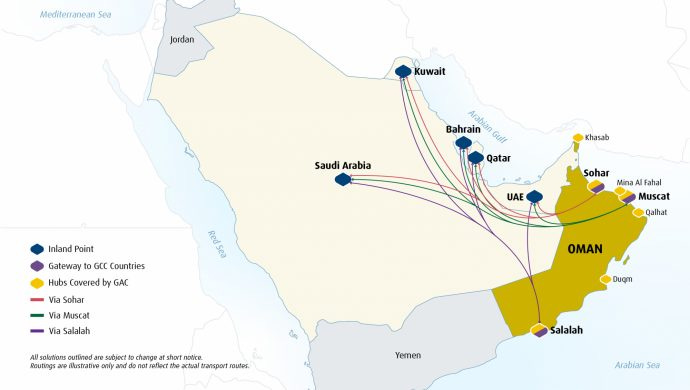
Given time for supply chains to adjust, these Omani ports could make Iran’s blockade less effective long-term, which may explain why, in the first days of this war, Iran bombed all three ports. That was not so great for Oman and, while Iran later apologized, the unspoken threat of further strikes remains.
Speaking of blockades: Iran only controls one side of that strait they’re blockading. Guess who sits on the other side?
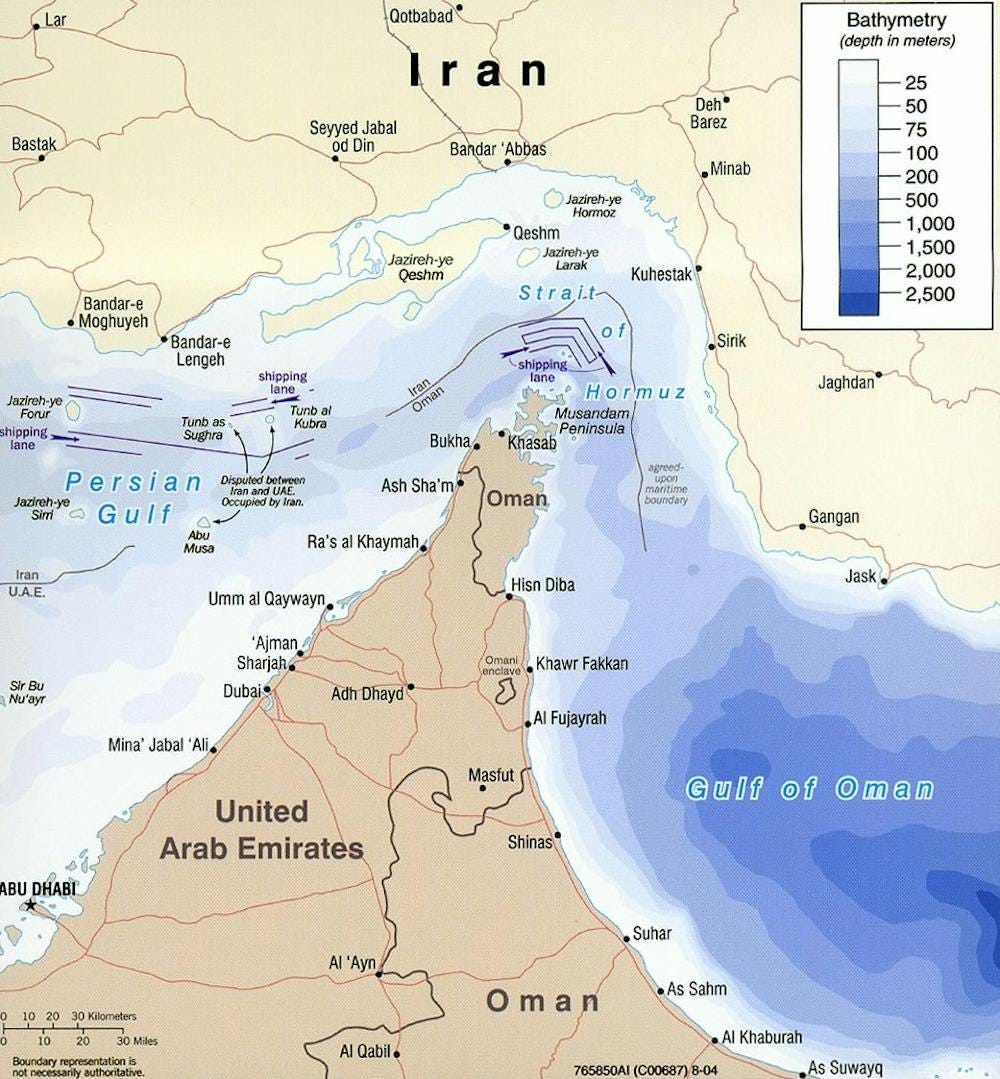
At first glance, it looks like the UAE controls the strait, but look again. The tip of that peninsula jutting into the strait is an Omani enclave. Keep in mind that national waters extend 12 miles from a nation’s coastline, and that the Strait of Hormuz is just 30 miles across at its narrowest point.
For Iran, Oman is a lot more than a convenient place to host discussions. This is a country that can make or break their plans. Oman lays claim to half of that strait they’re blockading and offers the most convenient alternate ports. Neutrality just won’t cut it anymore. Only a partnership will do.
On April 6th, Iran released a 10-point plan for peace through intermediaries in Pakistan. This plan contained the now-infamous “toll both” proposal in which Iran would, in perpetuity, collect about $2 million from each ship that traverses the strait. That revenue, Iran claimed, would be split evenly with Oman.
Two days later, Oman announced it had no intention of collecting any tolls, which would violate both Omani trade agreements and the Law of the Sea. The agreement would also have meant the end of Oman’s geopolitical neutrality and the beginning of a rogue state era.
Oman is in a precarious position. Any partnership with Iran opens the door to American military action, while remaining neutral and keeping their ports open invites Iranian military action.
One more time with feeling, Mr. Al-Busaidi:
Arab countries that had placed their trust in American security co-operation now experience that co-operation as an acute vulnerability, threatening their present security and future prosperity.
Last Sunday, Iran’s foreign minister Abbas Araqchi traveled to Oman’s capital to meet with both Al-Busaidi and the Sultan himself. “The Foreign Minister expressed appreciation for Oman’s responsible approach in facilitating diplomatic processes,” Iran’s ministry of foreign affairs stated in a press release. “He further emphasized Iran’s determination to safeguard friendly relations with Oman and other countries in the southern Persian Gulf region.” According to Axios, however, their talk centered largely around the Strait of Hormuz itself. PBS reports that Iran once again tried convince Oman to go halfsies on that toll.
I didn’t have a great time in Oman. If I could do that trip over again I think would do better, but I failed to gain the access my editors and I wanted. The authorities who run the space program were very concerned about a hit piece, and the possibility of positive coverage seemed to mean very little to them. Oman’s culture is friendly, sure, but they are looking out for number one just as ruthlessly as any other country. Neutrality has paid dividends for them so far, and they’ve taken full advantage of the resulting peace to build infrastructure and modernize the nation. What happens if American friendship solidifies into a liability with no upsides? If Trump continues to snub their leadership and Iran continues to court it?
I’m not saying Oman changes their position tomorrow, or next year, or ever—navigating impossible situations is their specialty, after all. What I am saying is that Trump is a loser. He’s losing this war. He’s losing the global economy. And if Oman manages to maintain its neutrality, it will be despite Trump’s best efforts to lose that too.
Thank you so much for this! In reading to better understand the Gulf nations and our current situation, I came across Oman and Ibadhi Islam and found it fascinating. Suddenly the reason for their being the location for prior negotiations (between Iran and the other Gulf states) made much more sense. I didn't understand why Pakistan was being used more recently or what that signified (nothing good). Trying to sort propaganda from reality when there's so many factors involved and bad faith actors abound is difficult. Pakistan itself is home to the largest Ahmadiyya population. I don't believe that's a factor presently but it was interesting because many Pakistani-Americans are of this faith.
Really informative, Laura, thank you. I really knew nothing of Oman’s previous role in negotiations. Eye-opening!.